ART & CULTURE CELL
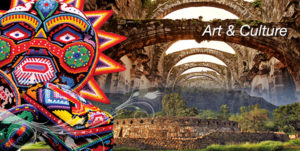
Art is a personal and cultural phenomenon which now and then motivates some people to express some of their ideas in a variety of shapes and ways. Some people create art to communicate something; others do it to express something; others, to avoid something from being understood but still express it. Motivations are so varied as art itself. Art flows between love and hate, admiration and denouncement, pleasure and pain… you name it, there is art for it and art against it.
We may divide art into two categories 1. Visual art & 2. Performing Art
The visual arts are arts that we see. This category usually includes just things that we see and things that are flat or two-dimensional. Visual arts are things like paintings, drawings, visual designs, photography, and computer art.
Because “visual arts” means two-dimensional things, sculpture and architecture come under separate headings. Likewise, visual works of art stay in one place, unmoving, while we observe them. For this reason, performing arts– stage, screen, music, and dance arts–also come under their own separate headings.
Remember that art is a language all of its own that is different from our normal spoken language. The language of the visual arts–like the other arts–is feeling: emotion, intuition, and form or idea without words. Through paintings, drawings, and other visual arts, we can discover worlds of experience that are all around us–or inside of us–that cannot be described quickly or easily with mere words. The visual arts can help us give meaning to what seems meaningless and help us recapture feelings and experiences that we have once had or would like to have again.
POWERFUL PAINTINGS
The visual arts are especially powerful for most people.
They are powerful because, first, we are a very visual race. Human beings are primarily visual sensors of five- sense data. Second, so much of what we experience can be identified and recalled much more quickly with one picture– “A picture,” the old saying goes, “is worth a thousand words.” And third, we have parts of our brains very well trained from infancy to absorb and process visual images, brain parts that are quite different from those that process verbal thinking. So we are very primed and ready for the visual stimulation of the visual arts.
When an artist creates a visual work of art such as a painting, he or she is communicating with us just as surely as if she were talking to us. Her “words,” though, are not spoken things, but rather are color, line, shape, and texture. There are so very many things that go into making a visual art work what it is, and so very many different things an artist can say just by making the different combinations.
For example, what does red make us feel? What does grey? What does a bunch of sharp, jagged lines, as opposed to a series of gentle curves, make us feel, especially when they are drawn in forms we recognize such as sharp, jagged eyebrows or gently curving ones?
There are so many other ways, too, that an artist can “talk” to us. We are supposed to feel something when looking at a painting or other work of art: we are supposed to react to it, even if the painting makes us react with tears, anger, or discomfort. Paintings and works of art in general are meant to move us, especially in ways that words often can’t. When we search for the meaning of a painting, we shouldn’t be looking for some kind of abstract symbolic meaning or other intellectual idea. It may be there intellectually, or it may not. Either way, what really is there is feeling–that is what we should search for first in trying to figure out what a painting or photograph “means.”
By letting ourselves aim to discover the feelings of a visual work of art, we can develop a more wide and far- seeing eye for what the artists really were trying to do.
TYPES OF VISUAL ARTS
Here is a list of some visual art forms (ones not considered as sculpture, plays, dance, or the like). They are listed by mediums–by the types of “canvas” and “paint” used to created them.
- Painting/Drawing (2-dimensional medium)
- oil/acrylic
- charcoal/pastel
- pencil drawing
- watercolor
- photograph/poster
- lithograph
- silk-screen
- cartoon/comic
- Carving/Weaving (3-dimensional medium)
- engraving
- woodcut
- etching
- stained glass
- mosaic
- stage setting
- tapestry
- carved design or picture
- Electronic Art (light/digital medium)
- computer art
- abstract video
- Web art
- photograph/poster
- stage setting
- light display
- cartoon/comic
- digitized video
- Oils are oil-based paints. Today, most artists use synthetic oils known as acrylics. Charcoals and pastels are sticks of chalk-like substances that come in black (charcoals) and pastel colors (pastels). Watercolors are water-based paints.
- Photographs, posters, and comics are images placed on paper from reality or from originals by a photocopying process. Sensitive chemicals react to different light, darkness, and colors to create copies of those shades and colors on paper. Modern newspapers and books are made by photocopying–use of light-sensitive chemicals. In older times, newspapers and books were made from engraved letters (see “engravings” below).
- Lithographs are prints made when a flat stone or a sheet of metal is treated with chemicals that either hold ink or repel it. A picture is drawn with chemicals that hold ink, and the white or blank spaces in the picture are treated with chemicals that repel ink. Then the picture is inked and laid on paper so that the ink-holding parts leave an ink print on the paper. Many such prints often can be made from one original before the chemicals wear out.
- Silk-screen prints are made when silk or other fine cloth is treated with ink-proof substances. The cloth is framed tightly, and then the parts that will be blank or white in the final print are treated with an impermeable chemical or substance that ink cannot go through. Then paper is laid under the silk-screen, and ink is forced through the part of the cloth that is untreated. The resulting image is called a silk-screen.
- Engravings are prints made from hard surfaces–usually wood or metal–that have been carved. Some areas of the wood or metal are carved out, and others are left as they were. Then the wood or metal is given a coat of ink just on the outer surface of the carved areas–just on the remaining high parts–and laid on paper. The resulting print or “engraving” will show ink where the high parts are on the wood or metal, and the print will show white spaces where the carved out areas are on the wood or metal.
- Imagine, for example, an alphabet block with the letter “A” carved into its surface. If the side of the block was inked and then laid on a piece of paper, the result would be an ink print that showed a black square with a white “A” inside of it.
- Woodcuts and etchings are engravings made from wood (woodcuts or woodblocks), or metal plates and stone sheets (etchings). Etchings are so named because the metal plates or stone sheets are etched or carved chemically with acids instead of carved as is wood by hand or machine.
- Stained glass is created by making colored sheets of glass, cutting them into pieces, and joining them together with thin lengths of lead.
- Mosaics are made in similar ways, usually with tile or some other form of masonry, except that the pieces of tile are laid into a glue-like cement base.
- Tapestries are, in a sense, cloth carvings. They are woven cloth designs and usually are meant for hanging on walls.
- Electronic arts are relatively new to the human race. The visual arts forms of electronic arts include computer- generated designs, cartoons on TV and videos, and abstract videos–those with no real people or things in them. Videos and TV with real people and things usually are classified with the stage arts (the performing arts), along with plays, dance, and musical performances. Some of the more innovative video and stage shows also have very creative stage settings or light-show displays, and these probably are visual arts, too. In most recent years, digitized photographs and sections of movies have developed, and this trend of digitizing visual images promises to become a dominant part of photography and movie making in the next few decades.
- Gastronomy, which is the art of mixing flavours and causing pleasures with meals.
- Gold-smithery, silver-smithery, and jewellery, the art of creating jewels.
- Body art, which uses the human body for expression as canvas, like tattoos or make-up
- Brief art, made in such a way it will not last long, like fruit sculpture
“Real” Versus “Abstract”
Another simple but important way to label or categorize the visual arts is not by medium, as above, but rather by how realist or abstract the artistic creations are. Some visual arts automatically are much more realistic (e.g. photography), while others are automatically abstract (e.g. light displays).
In fact, often we get a bit edgy when we hear about or see “abstract art.” We wonder what others see in it, especially when it is so abstract that we cannot even see anything remotely like a person, place, or thing within it.
It might be helpful for us in such situations to remember that we already thoroughly enjoy some forms of so- called “abstract art.” Music without words is abstract. So are the arches of MacDonald’s hamburger stands and most other buildings modern and old. Light shows are abstract. So are natural sculptural forms that are pleasant to touch such as rocks pleasant to hold in the hand, fur that is pleasant to stroke, and the feel of different clothing on our skins.
All these experiences are abstract–without content. Some of them we enjoy and some we don’t. So when we are confronted by abstract visual art, it may help us if we just let the visual forms and swirls and geometric patterns and colors fill up our eyes and our heads–will such a piece then affect us like being swept away by music or stroking fur? Or will it still leave us cold? This is a better way to approach abstract visual art–a way that can open some of it to us and help us understand why it does appeal to some people.
Performing Arts
Performing arts are art forms in which artists use their voices and/or the movements of their bodies, often in relation to other objects, to convey artistic expression—as opposed to, for example, purely visual arts, in which artists use paint/canvas or various materials to create physical or static art objects. Performing arts include a variety of disciplines but all are intended to be performed in front of a live audience.
Performing arts may include dance, music, opera, theatre and musical theatre, magic, illusion, mime, spoken word, puppetry, circus arts, performance art, recitation and public speaking.
Theatre
Theatre is the branch of performing arts; concerned with acting out stories in front of an audience, using a combination of speech, gesture, music, dance, sound and spectacle. Any one or more of these elements is performing arts. In addition to the standard narrative dialogue style of plays. Theatre takes such forms as plays, musicals, opera, ballet, illusion, mime, classical Indian dance, kabuki, mummers’ plays, Cinema, improvisational theatre, stand-up comedy, pantomime, and non-conventional or contemporary forms like postmodern theatre, post dramatic theatre, or performance art.
Dance
In the context of performing arts, dance generally refers to human movement, typically rhythmic and to music, used as a form of audience entertainment in a performance setting. Definitions of what constitutes dance are dependent on social, cultural, aesthetic artistic and moral constraints and range from functional movement (such as folk dance) to codified, virtuoso techniques such as ballet.
Dance is a powerful impulse, but the art of dance is that impulse channeled by skillful performers into something that becomes intensely expressive and that may delight spectators who feel no wish to dance themselves. These two concepts of the art of dance—dance as a powerful impulse and dance as a skillfully choreographed art practiced largely by a professional few—are the two most important connecting ideas running through any consideration of the subject. In dance, the connection between the two concepts is stronger than in some other arts, and neither can exist without the other.
Choreography is the art of making dances, and the person who practices this art is called a choreographer.
Cinema, the art of creating sensations with recorded movements and dialogues.
What We Aim to Do
- To serve as a major resource centre for the arts, especially written, oral and visual source materials.
- To undertake research and publication programmes of reference works, glossaries, dictionaries and encyclopedia concerning the arts and the humanities.
- To establish a tribal and folk arts division with a core collection for conducting systematic scientific studies and for live presentations.
- To provide a forum for a creative and critical dialogue through performances, exhibitions, multi-media projections, conferences, seminars and workshops between and amongst the diverse arts, traditional and contemporary.
- To foster dialogue between arts and current ideas in philosophy, science and technology, with a view toward bridging the gap in intellectual understanding between modern sciences and arts and culture.
- To evolve models of research programmes and arts administration more pertinent to the Indian ethos.
- To elucidate the formative and dynamic factors in the complex web of interactions between diverse social strata, communities and regions.
- To promote an network with national and international institutions.
- To conduct related research in the arts, humanities and culture.